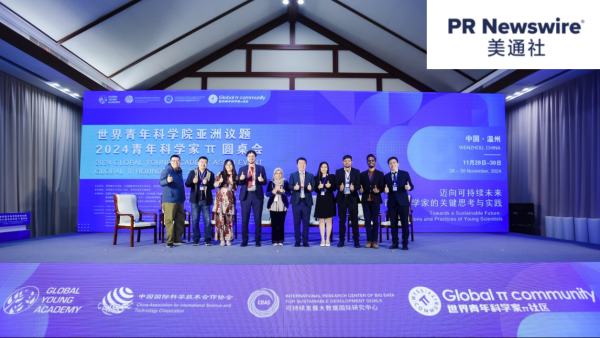
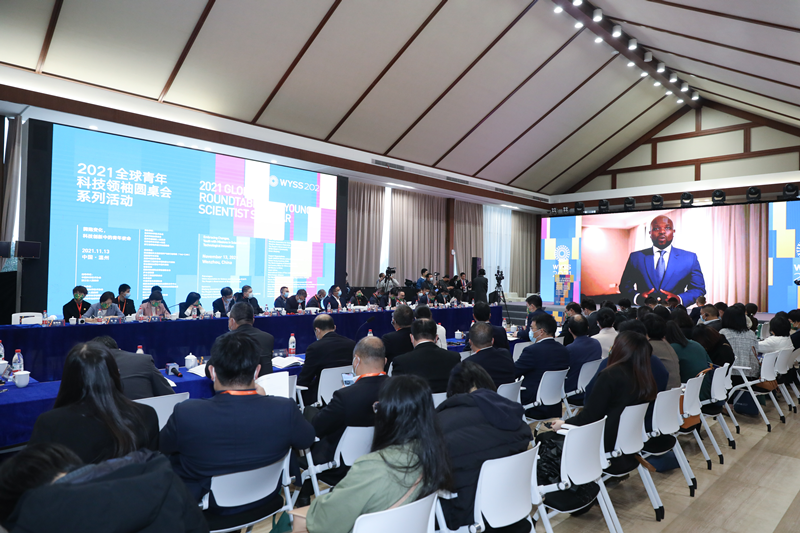
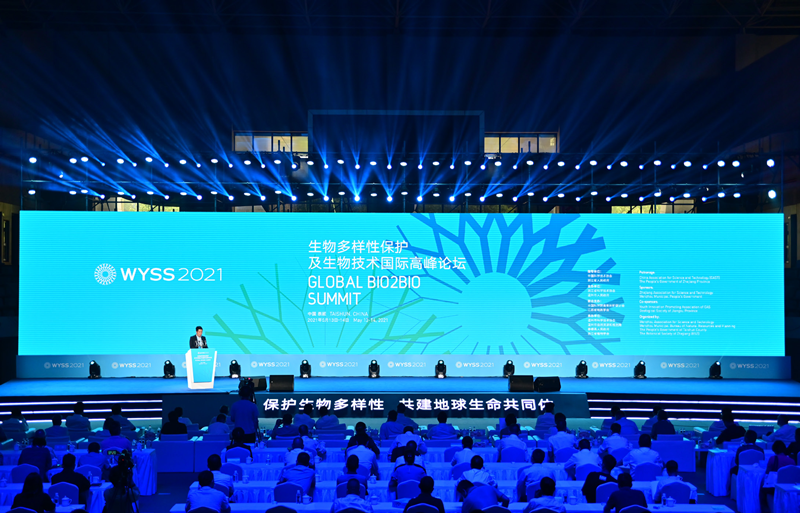
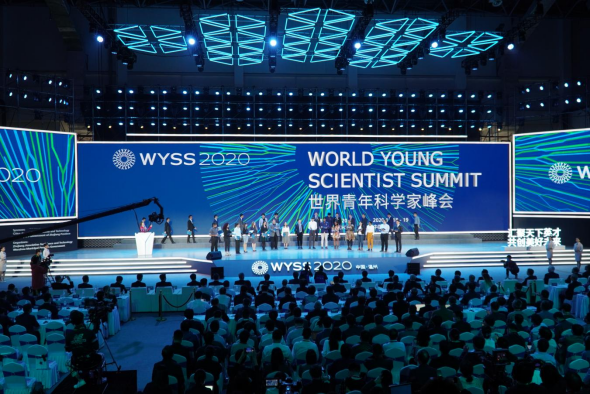
“make cities more resilient and villages richer!” On the morning of December 9, the opening ceremony of the 2023 International Symposium on Resilient Cities & the 23rd Annual General Meeting of UK-CARE took place in Cangnan. Academicians, experts, and technology elites from around the world, along with entrepreneurs, gathered to collectively discuss the application of interdisciplinary methods in building secure, green, and livable digital resilient cities, aiming to achieve the integration of urban and rural areas and sustainable development of resources and the environment! Concurrent activities of the symposium took place at Shenyang University in China and Loughborough University in the United Kingdom.Prof. Huadong Guo, Academician of the CAS, Director of the International Research Center of Big Data for Sustainable Development Goals and Dr. Xiaoming Jin, Director of the Professional Committee of Science Diplomacy of China Association for International Science and Technology Cooperation attended the opening ceremony and jointly unveiled the Center for Applied Future Engineering and Science (CAFES). Municipal and county leaders Ms. Yueying Zhang, Mr. Benfeng Zhang, Mr. Renhai Zeng, and others participated in the opening ceremony.In recent years, due to the continuous acceleration of the global urbanization process, urban spaces have become increasingly compact, and population distribution has become more concentrated. Enhancing urban resilience and increasing the ability to withstand risks have become significant challenges in the modern management of urban construction. On the other hand, with global climate change, natural disasters such as high temperatures, floods, and droughts are becoming more frequent. Risks such as infectious diseases, sudden social events, and major safety accidents are also on the rise. The impacts on urban development are increasingly significant. While people are paying attention to disasters and events, they are also more aware of the importance of building “Resilient Cities.”As one of the significant events of this year's World Young Scientists Summit(WYSS), this symposium, within the framework of the WYSS and in response to the resilience needs of Cangnan's urban development, addresses topics such as urban geology and the secure development of underground spaces, intelligent cities for extreme situations, innovative approaches to water and food security in response to agricultural non-point source pollution, and innovative responses to an aging society. It aims to explore “Constructing safe, green, and livable digital resilient cities, in the context of sustainable development of natural resources and environment” The symposium further aims to enhance the establishment of an international platform for young scientific and technological talents, attracting outstanding young scientists worldwide to contribute their efforts to sustainable development and technological innovation.During the ceremony, Dr. Young Joo Lee, Director of the CCOP Technical Secretariat (CCOPTS), Dr. David Govoni, President of the European Federation of Geologists, Mr. Li Dai, Secondary Inspector of Zhejiang Association for Science and Technology, Ms. Yueying Zhang, the Vice Mayor of Wenzhou, and Mr. Benfeng Zhang, the secretary of the county Party committee of Cangnan each delivered speeches on stage. Additionally, Mr. Daniel Brooker, Director of UKRI China, Dr. Remy Sietchiping, Chief of Policy, Legislation and Governance Section within the Urban Practices Branch of UN-Habitat, and Mr. Ruixiang Song, Former Minister of Geology and Mineral Resources provided video addresses. In her address, Ms. Yueying Zhang remarked: “People often say that Wenzhou residents are the most resilient group in China, and I sincerely hope that this city can also become the most resilient city. I am eagerly anticipating that through this symposium and annual meeting, we can further learn and exchange advanced ideas and technologies for building resilient cities. Let's discuss and share new models and pathways for achieving resilient cities and sustainable urban development. At the same time, I hope that experts and scholars can provide valuable insights into the urban development of Wenzhou and Cangnan. Share your expertise generously with Wenzhou, so that more research achievements can be applied to the development of Wenzhou and Cangnan cities. Let more high-caliber talents participate in the development of Wenzhou, collectively seize development opportunities, and create a better future together.” In his address, Mr. Benfeng Zhang expressed: “Hoping that experts and scholars can, leveraging their professional expertise and international perspectives, diagnose and offer insights for the resilient urban development of Cangnan. Through exchange, discussion, and intellectual collisions, let's yield fruitful results in urban ecological construction. Provide optimal examples for the organic integration of natural forms and urban spaces, making cities more low-carbon, intelligent, and harmonious. In the inheritance of urban context and the cultivation of urban cultural brands, let's achieve significant outcomes. Provide the best solutions for promoting resilient urban construction and development through cultural innovation, making cities more vibrant and appealing. In the integration of industry and urban development, let's produce remarkable results. Provide optimal models for advancing urban development and construction, making cities not only aesthetically pleasing but also more valuable.”Mr. Zeng Renhai, the County Mayor of Cangnan and Dr. Pavlos Tyrologou, Editor In Chief of the European Geologist Journal, External Relations Officer of the European Federation of Geologists jointly unveiled the plaque for the China-UK Mangrove Wetland Ecological Research Center. The establishment of this center aims to better serve the ecological restoration project of the Mangrove Wetland Ecosystem along the Pupu Bay in Cangnan. It will facilitate interdisciplinary and cross-regional collaboration between “production, academia, and research” continuously enhancing the reputation of the “largest bay mangrove ecological wetland on the northern edge of China.”During the keynote address phase, Prof. Huadong Guo delivered a presentation on "Digital Earth Supporting Sustainable Development Goals." He elaborated on the challenges faced in utilizing large-scale Earth data to achieve sustainable development goals, such as data shortages, insufficient research on indicators, and regional development imbalances. Guo showcased China's establishment of the International Research Center for Sustainable Development Big Data and highlighted significant cases where big data has been used to assist in advancing the United Nations Sustainable Development Goals (SDG 2030), placing China at the forefront globally. He emphasized that harnessing Earth big data plays a crucial role in enhancing resilient and secure urban construction, as well as achieving the integration of urban and rural areas and sustainable development of resources and the environment.In addition, Dr. Lesley Palmer, Director of Dementia services development Centre of the University of Stirling delivered a keynote address titled "Challenges of Healthy Aging and a Case Study from the UK." Academician of the CAS, Professor of Nanjing University, Prof. Zhiqin Xu, shared the report "Legendary Earth: Stories Told by Stones" through live connection, narrating the mysteries behind stones and the story of Earth's transformation.During the interactive session, participants also engaged in discussions around “Financing for Building Resilient and Livable Communities and Cities” They shared and discussed successful financing models, collaborative mechanisms, and other aspects in the practice of building resilient cities. This exchange provided valuable experiences for the construction and development of resilient cities in China.